
On September 21st, 2024, HealthAI.id hosted an intensive Deep Learning Workshop, where participants delved into advanced AI techniques for healthcare applications. The workshop, led by Arief Purnama Muharram, M.D., M.Sc., attracted a diverse group of professionals, students, and researchers eager to enhance their understanding of deep learning and its real-world applications, specifically in healthcare.
Session 1: Reviewing Deep Learning Fundamentals
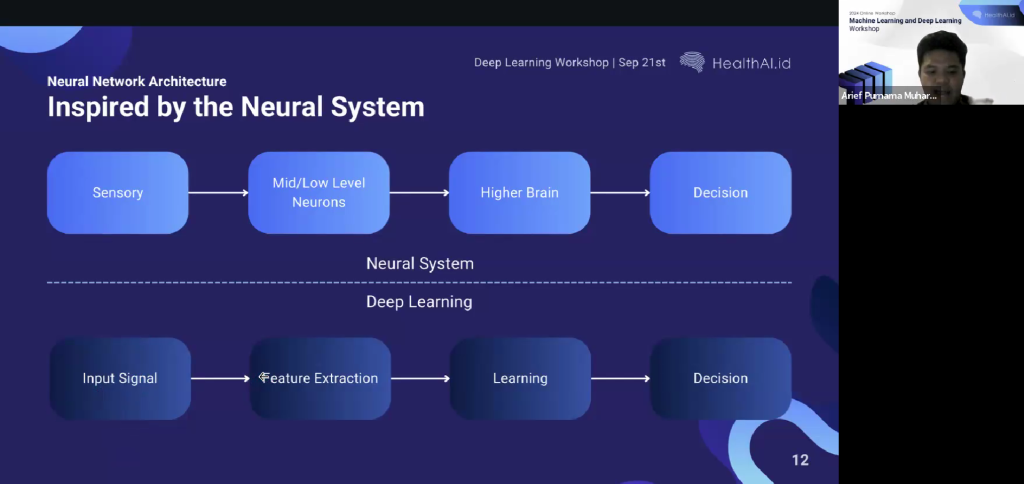
The workshop began with a comprehensive overview of deep learning fundamentals. The speaker covered key topics, such as:
- Why Choose Deep Learning?
Participants learned why deep learning is the preferred method for solving complex problems in healthcare, especially in image analysis, diagnostics, and predictive analytics. - Development Life Cycle of Deep Learning Models:
This section covered the stages involved in building a deep learning model, from data preprocessing to training, validation, and fine-tuning. - Inspiration from Neural Systems:
The discussion extended to how deep learning models, particularly neural networks, are inspired by the workings of the human brain’s neural systems. The speaker explained how neurons and synapses work in concert to enable complex decision-making processes in AI models. - The Math Behind Deep Learning:
To give participants a deeper understanding, there was a segment dedicated to the mathematical foundations of deep learning, including matrix operations and backpropagation. - Introduction to Transfer Learning:
The fundamentals of transfer learning were also covered, showing how pre-trained models can be fine-tuned for specific tasks, reducing the amount of data and training time required for effective model deployment.
Session 2: Getting to Know Python and Google Colab
In the second session, participants were introduced to practical tools: Python and Google Colab. The speaker demonstrated how these tools, particularly key libraries like TensorFlow and Keras, are used to implement deep learning models. The Google Colab platform was emphasized as an accessible, cloud-based solution for running Python code, enabling participants to experiment with model-building in real-time.
Session 3: Hands-On Model Development with Diabetic Foot Ulcer Dataset
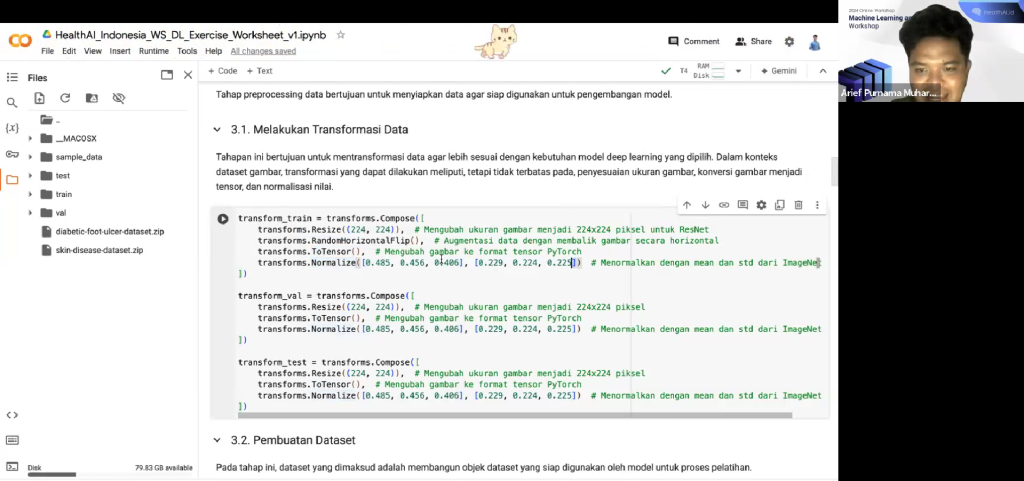
The final session focused on applying theoretical knowledge through hands-on experience. Participants worked with the Diabetic Foot Ulcer Dataset, building a deep learning model to classify images related to diabetic foot ulcers. This exercise allowed attendees to:
- Preprocess and augment data to improve model performance.
- Train a deep learning model using convolutional neural networks (CNNs) to classify medical images.
- Test and evaluate the model’s accuracy and fine-tune parameters to optimize results.
The hands-on nature of this session provided participants with valuable experience in developing and deploying deep learning models for real-world medical applications.
Conclusion
The Deep Learning Workshop concluded with a lively Q&A session, where participants discussed their experiences, shared insights, and sought advice on applying deep learning to their own projects. The workshop successfully combined theoretical learning with practical application, offering a holistic view of deep learning’s power in healthcare.
Stay tuned for our upcoming events, where we will continue exploring how AI can revolutionize the healthcare industry!
Leave a Reply